
Most interior painting jobs turn up something that needs repairing first, and we do that work ourselves rather than sending you to find a second contractor and then waiting on their schedule.
What we repair
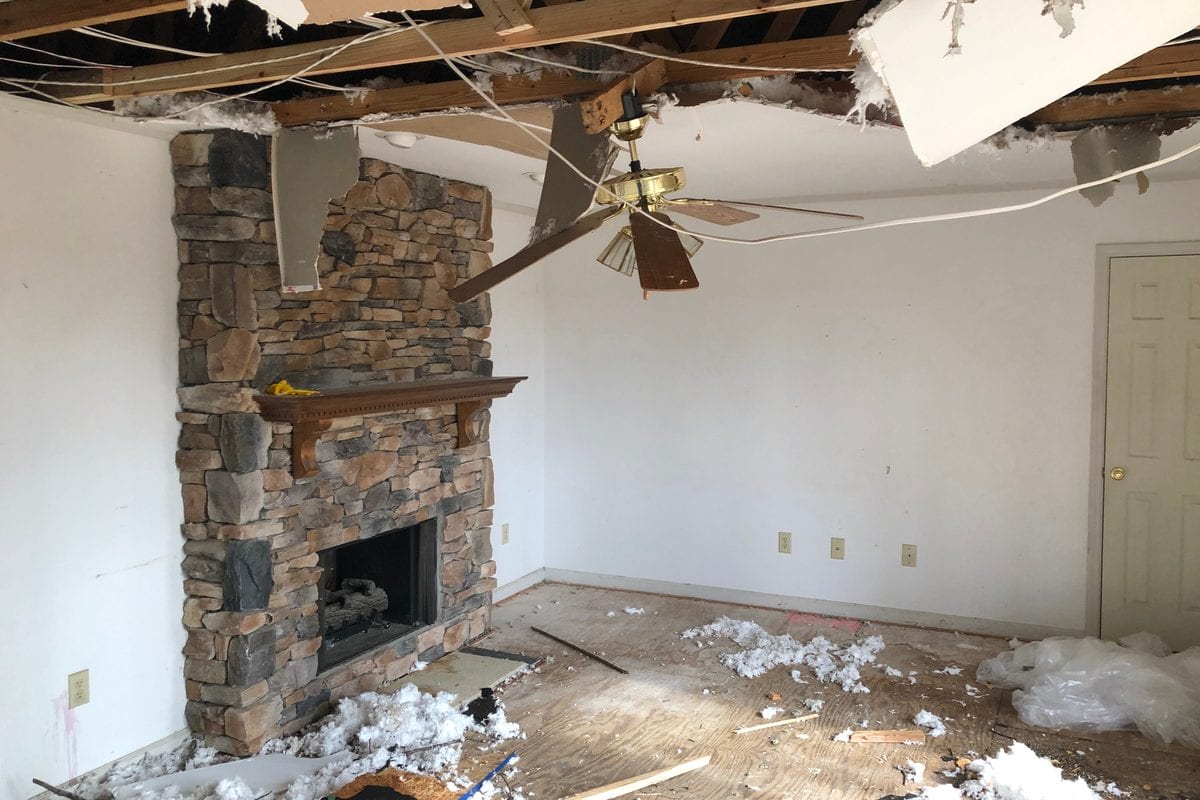
Nail pops and screw pops, which are the wall telling you the framing behind it has moved with the seasons. Hairline cracks at the corners of doors and windows, where drywall is weakest and the house flexes most. Seam and tape cracks. Holes, from doorknob-sized to sheet-sized. Corner bead that has been knocked and dented. Water damage, once the leak causing it has been fixed. And the ceiling damage that turns up constantly under old popcorn texture once it comes off.
Doing it so it does not come back
A nail pop filled flush and painted will pop again, because nothing was done about the fastener. The fix is to drive a screw an inch or two away into solid framing, pull the board tight, then remove or reset the original fastener and finish over both.
Cracks that keep reopening are usually structural movement rather than a bad joint, and filling them with compound alone guarantees a repeat. Those get taped — paper or mesh depending on the location — and feathered properly.
Bigger holes get a backed patch or a cut-in piece of board screwed to framing or to a batten, not a mesh patch bridging fresh air, which telegraphs a square outline through the paint in the first year.
Texture matching
This is the part that separates a repair you can see from one you cannot. Triad houses carry everything from flat smooth walls to knockdown, orange peel and the heavier hand textures of the 1970s and 1980s. A patch finished smooth in the middle of a textured wall is as obvious as the hole was. We match the surrounding texture, then prime the repair before painting, because bare compound absorbs paint at a completely different rate from the wall around it and flashes dull under any sheen above flat.
Where it is bare compound, it gets primed
Every time. It is the single most common reason a well-executed repair still shows in the finished wall.
Honest limits
If a ceiling is sagging, if a crack is widening across a season, or if the damage traces back to a roof or plumbing leak that is still live, that is a different trade's problem first. We will tell you that at the estimate rather than patching over it and letting you discover it later.
Lisa B. had sheetrock repaired in her dining room and kitchen before we painted, and that is the usual shape of the work: the repair is a means to the paint job, and both have to be right.